Artificial Intelligence (AI) is no longer a concept from sci-fi movies — it has become a part of our daily life. Whether it’s unlocking your phone with Face ID, getting product recommendations on Amazon, or chatting with virtual assistants, AI is working silently behind the scenes.
As we step into 2026, AI has grown faster than ever before, and understanding it has become essential for students, professionals, and business owners. This beginner-friendly guide explains AI in simple words, covers how it works, its types, real-world uses, benefits, dangers, and the future ahead.
1. What Exactly Is Artificial Intelligence?
Artificial Intelligence (AI) is a branch of computer science that makes machines think, learn, and solve problems like humans.
In simple words:
👉 AI = Machines that can understand, learn, decide, and improve over time.
AI does not just follow instructions; it learns from data and makes smarter decisions.
Everyday Examples of AI
- Google Maps predicting the fastest route
- Netflix recommending movies
- Chatbots replying to customer queries
- Smart assistants like Siri, Alexa, and Google Assistant
- Self-driving cars adjusting speed and direction
These systems observe, learn, and act — just like humans.
2. How Does AI Actually Work? (Simple Explanation)
AI works by using data, algorithms, and computing power.
Here’s a simple breakdown:
Step 1: Input Data
AI learns from huge amounts of data:
- Photos
- Text
- Videos
- Voice
- Numbers
Step 2: Algorithm
Algorithms help AI identify patterns — similar to how humans learn from examples.
Step 3: Training
AI models are trained:
- Show thousands of photos of cats
- The system learns what a “cat” looks like
- Next time it can identify a cat in a new photo
Step 4: Predictions
Once trained, the AI can:
- Recognize faces
- Predict weather
- Translate languages
- Recommend songs
Step 5: Improvement (Machine Learning)
The more data AI gets, the smarter it becomes.
3. Types of Artificial Intelligence
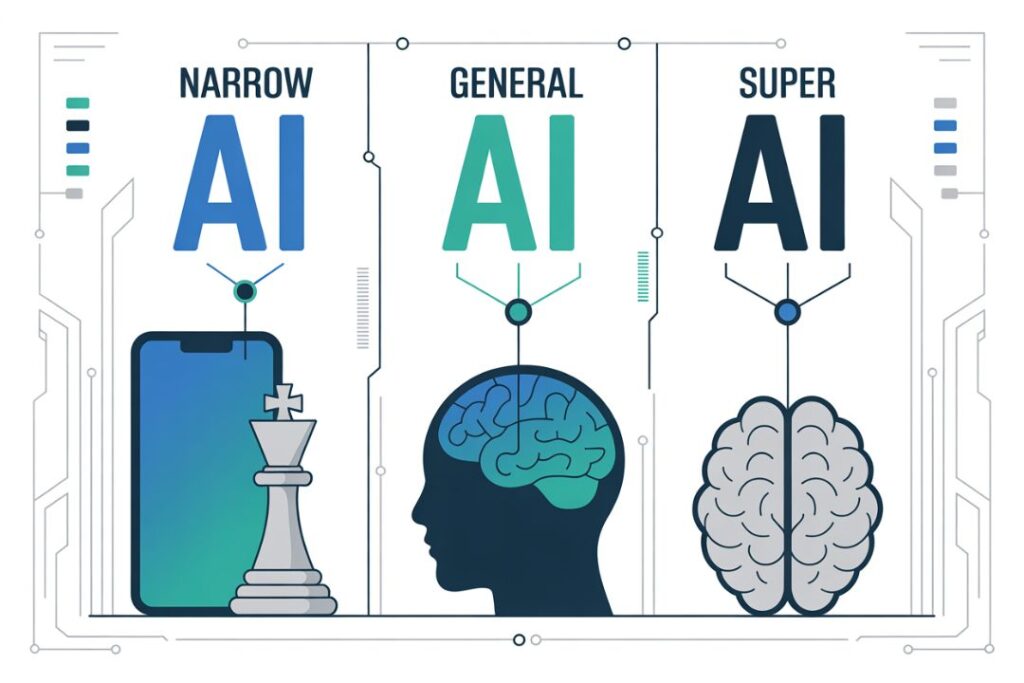
AI is divided into multiple categories. Understanding these helps you know what AI can — and cannot — do.
A. Based on Capability
1. Narrow AI (Weak AI)
- Focuses on a single task
- Is the only type of AI we have today
Examples: - ChatGPT
- Google Search
- Image recognition
- Voice assistants
2. General AI (Strong AI)
- Thinks and learns like a human
- Can perform any intellectual task
- Still under research
3. Super AI
- More intelligent than humans
- Only theoretical (not real yet)
B. Based on Functionality
1. Reactive Machines
- No memory
- Only respond to the current situation
Example: IBM’s Deep Blue (chess-playing machine)
2. Limited Memory
- Learns from past data
- Used in today’s modern AI
Example: Self-driving cars
3. Theory of Mind
- Future AI that understands emotions and social interactions
(Not developed yet)
4. Self-Aware AI
- Machines with consciousness
- Still completely hypothetical
4. Machine Learning vs Artificial Intelligence — Are They the Same?
Many people think AI and Machine Learning (ML) are the same.
They are connected, but not identical.
AI is the big concept
It includes anything that makes machines intelligent.
Machine Learning is a part of AI
It focuses on training machines with data.
AI = the field
ML = a method to achieve AI
5. Why Is AI So Important in 2026?
AI is becoming the backbone of innovation.
Here’s why it matters:
✔ Faster Problem Solving
AI handles complex tasks faster than humans.
✔ Automation
Repetitive tasks like emails, paperwork, and data entry are now automated.
✔ Better Decision Making
AI analyses data and provides accurate insights.
✔ Cost Reduction
Businesses save millions using AI tools.
✔ Higher Efficiency
AI tools do tasks 10x faster with fewer errors.
✔ Personalization
Virtual assistants and apps customize user experience.
6. Real-Life Applications of AI (2026)
AI is everywhere — from healthcare to gaming to agriculture.
Here are the major industries using AI today:
1. Healthcare
- AI diagnoses diseases faster
- Medical image analysis
- Drug discovery
- Robot-assisted surgeries
- Predicting health risks
Example: AI systems can detect early signs of cancer with 95% accuracy.
2. Education
- AI tutors
- Personalized learning
- Automatic grading
- Student performance prediction
Students now learn faster because learning materials adjust to their pace.
3. Business & Marketing
- AI chatbots
- Sales predictions
- Customer behavior analysis
- Social media automation
Businesses use AI to increase conversions and reduce workload.
4. Finance
- Fraud detection
- Stock market predictions
- Automated trading
- Loan approvals
AI analyzes millions of transactions in seconds.
5. Transportation
- Self-driving cars
- Traffic prediction
- Smart navigation systems
AI-enabled vehicles reduce accidents and save time.
6. Entertainment
- AI-generated music
- Personalized movie suggestions
- Gaming bots
- Metaverse enhancements
Platforms like Spotify and Netflix rely heavily on AI.
7. Security
- Face recognition systems
- CCTV monitoring
- Cybersecurity
- Threat detection
AI protects systems from hacking and data theft.
7. Advantages of Artificial Intelligence
AI brings many benefits to individuals, companies, and governments.
✔ Speed and Efficiency
AI performs tasks faster than humans.
✔ Zero Fatigue
AI works 24/7 without breaks.
✔ Reduced Human Error
AI minimizes mistakes in finance, medicine, and engineering.
✔ Data Handling
AI analyzes massive datasets in seconds.
✔ Availability
Virtual assistants are available anytime.
✔ Innovation
AI powers new technologies: robots, drones, smart devices.
8. Disadvantages of Artificial Intelligence
With benefits come challenges and risks.
❌ Job Loss
Automation can replace repetitive jobs.
❌ High Cost
AI development requires high investment.
❌ Privacy Issues
Data collection can be misused.
❌ Dependence on Machines
People may rely too much on AI tools.
❌ Ethical Concerns
AI-generated fake content can mislead people.
9. Will AI Replace Humans in the Future?
AI will not replace humans, but it will replace some tasks.
AI will replace:
- Data entry jobs
- Basic customer service
- Repetitive office tasks
- Manual calculations
AI will not replace:
- Creative jobs
- Emotional intelligence
- Leadership roles
- Strategic decision-making
Instead, AI will work with humans, helping them do their jobs better.
10. Future of Artificial Intelligence (2026–2030)
AI is expected to grow even faster in the coming years.
Future predictions:
- More powerful AI assistants
- Smarter self-driving vehicles
- Personalized medicine
- AI teachers for students
- AI in agriculture improving crop production
- AI-powered smart cities
- AI robots handling dangerous tasks
The future of AI is full of opportunities — but also requires responsible use.
11. How Can Beginners Learn About AI?
If you’re new, start with the basics:
Step-by-Step Path
- Understand basic concepts
- Learn Python
- Study Machine Learning
- Practice with datasets
- Learn AI tools
- Build small projects
Free platforms to learn AI:
- Google AI
- Coursera (free courses)
- YouTube tutorials
- Kaggle
You don’t need a degree — just consistency and curiosity.
1. What is Artificial Intelligence in simple words?
Artificial Intelligence is a technology that allows machines to think, learn, make decisions, and solve problems like humans.
2. What are the types of Artificial Intelligence?
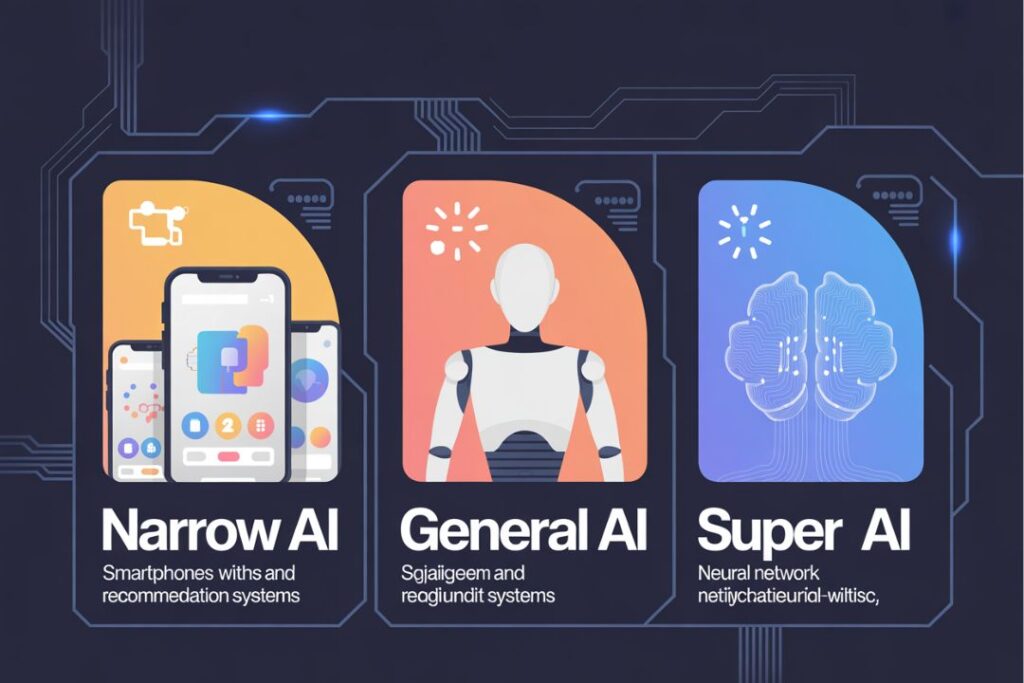
AI has three main types: Narrow AI, General AI, and Super AI. Today, only Narrow AI exists and is used in phones, apps, cars, and computers.
3. How does AI work for beginners?
AI works by learning from data. It observes patterns, trains using algorithms, and then makes smart predictions or decisions based on what it learned.
4. What are the advantages of Artificial Intelligence?
AI increases speed, reduces errors, automates tasks, saves time, and provides accurate analysis for businesses and individuals.
5. What are the dangers or risks of AI?
AI can cause job loss, privacy issues, over-dependence on machines, and ethical concerns like fake content.
6. Will AI replace humans?
AI will replace repetitive tasks, but not human creativity, emotions, leadership, or strategic thinking.
7. Where is AI used in real life?
AI is used in healthcare, smartphones, social media, finance, education, transportation, and online shopping platforms.
8. How can a beginner learn AI in 2026?
Start with basic concepts, learn Python, study machine learning, take online courses, and practice with small projects.
Conclusion
Artificial Intelligence is shaping the future of technology, businesses, and human life. As we move through 2026, AI continues to grow smarter, faster, and more powerful. Understanding AI is no longer optional — it’s a skill that can open doors to better jobs, better productivity, and better opportunities.
AI is here to stay.
And the more you learn, the more prepared you’ll be for the future.